The γ(3,4) triangle
Mark Burgess's Semantic Spacetime in one picture: three node kinds and four edge kinds — enough, in our reading, to sketch any observer's view of anything in space and time.
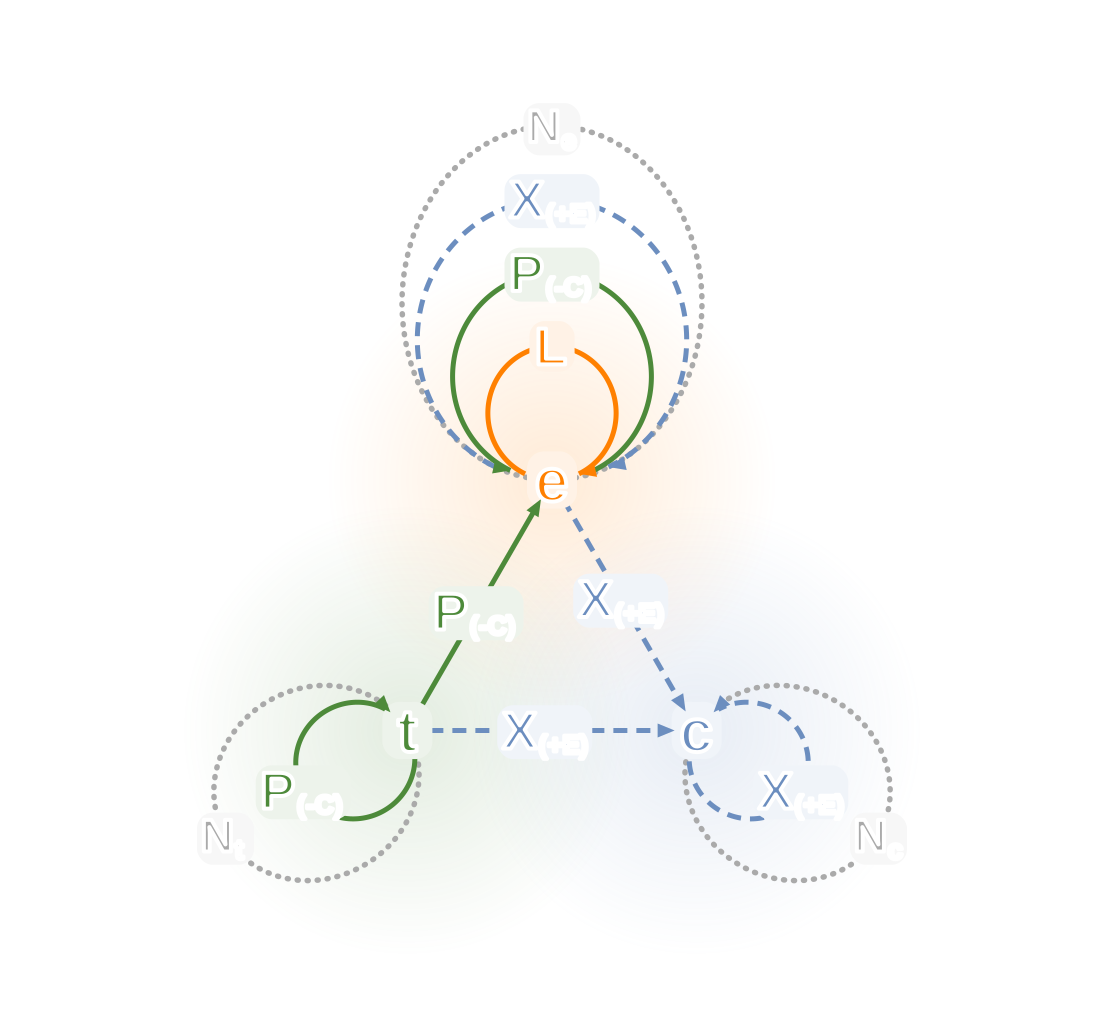
The three corners are e (event), t (thing) and c (concept). The arrows show every legal edge. A relation between two nodes of the same kind runs to a second node of that kind beside the corner (e with e2, and so on) — an event that leads to an event leads to a different event, and nothing points at itself. The outermost, dotted ring of each corner (Ne, Nt, Nc) is near-to — undirected similarity between two nodes of the same kind.
The three node kinds
| Kind | Symbol | What it is | Examples |
|---|---|---|---|
| Event | e | A transient happening — fast at the model's timescale | “User clicks button”, “Build runs”, “Plum murders Scarlet” |
| Thing | t | A persistent participant — slow at the model's timescale | “Alice”, “my laptop”, “service A container”, “knife K1” |
| Concept | c | A quasi-invariant pattern; a property that events or things express | “human”, “microservice”, “production”, “murder” |
The four edge kinds
| Sym | Render | Name | Meaning | When to use |
|---|---|---|---|---|
| L | orange | LEADS-TO | Temporal / causal flow | One event causes or precedes another |
| P | green | PART-OF | Containment / participation | A thing inside an event, a sub-event inside a parent event, or a sub-part inside a bigger thing |
| X | blue dashed | EXPRESSES | Property (a single promise) | An event or thing expresses a concept as a property; a concept can express another. Not is-a |
| N | gray dotted | NEAR-TO | Similarity / proximity (undirected) | Two same-kind nodes are alike but you don't want to merge them |
All 11 allowed edges
Every legal source → target combination, matching the triangle above. The syntax column shows the most common ipmt form. Step through them one slide at a time →
| # | Source → Target | Edge | ipmt syntax | Reads as |
|---|---|---|---|---|
| 1 | event → event | L | e1 ::e --> e2 ::e | e1 leads to e2 |
| 2 | event → event | P | inner ::e --::P--> outer ::e | inner event is part of outer event |
| 3 | event → event | X | e1 ::e --::X--> e2 ::e | e1 expresses e2 |
| 4 | event — event | N | e1 ::e --- e2 ::e | e1 is similar to e2 (and vice versa) |
| 5 | thing → event | P | tA --> e1 ::e | tA participates in (is part of) e1 |
| 6 | thing → thing | P | subpart --> whole | subpart is part of the whole (physical composition) |
| 7 | thing — thing | N | tA --- tB | tA is near / similar to tB (and vice versa) |
| 8 | event → concept | X | e1 ::e --> cX ::c | e1 expresses property cX |
| 9 | thing → concept | X | tA --> cX ::c | tA expresses property cX |
| 10 | concept → concept | X | cX ::c --> cY ::c | cX expresses property cY |
| 11 | concept — concept | N | cX ::c --- cY ::c | cX is similar to cY (and vice versa) |
Two rules baked into the table
- No
thing --> thingarrow except part-of. To say “Alice owns the car”, create an event that co-locates both participants and let it express the relation as a concept-property (Ownership ::c). The event is the temporal container; the concept names what the co-location means. - The bare
-->arrow defaults to the relation that fits the two node kinds: leads-to for event→event, part-of for thing→event and thing→thing, expresses for event→concept, thing→concept and concept→concept.